Confidence, Rebuilt: The Psychology of Dressing for Your Next Chapter
Quick answer: Clothing doesn't just reflect how you feel — psychology research shows it actively shapes it, a phenomenon called "enclothed cognition." If you're going through a career pivot, divorce, empty nest, or any fresh start, changing what's in your closet isn't vanity; it's one of the fastest, most evidence-backed ways to change how you show up. The catch is that most people don't know what to buy for the person they're becoming — which is exactly the gap AI shopping assistants are starting to close.
Why what you wear affects how you feel, not just how you look
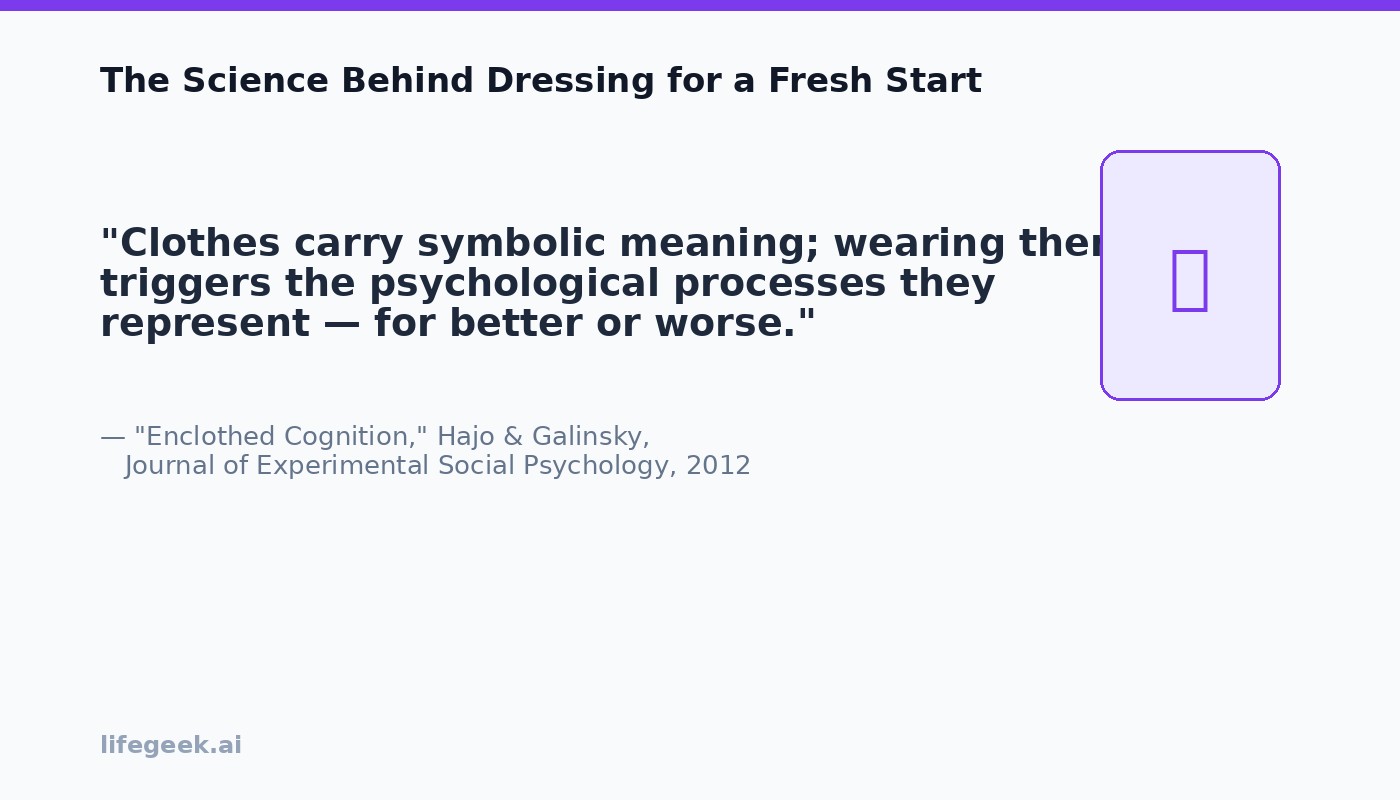
In 2012, researchers Hajo Adam and Adam Galinsky at Northwestern University published a study in the Journal of Experimental Social Psychology introducing the term "enclothed cognition." Their finding: participants who wore a lab coat they were told belonged to a doctor showed measurably better sustained attention on cognitive tasks than those who wore the same coat but were told it belonged to a painter, or those who didn't wear a coat at all.
The clothing was identical. The meaning attached to it changed how people's minds worked.
That result has since been widely cited and replicated in variations — Wikipedia's summary of the research notes follow-up studies linking clothing choices to confidence, negotiation outcomes, and even risk-taking behavior. The underlying idea is simple: clothes carry symbolic meaning, and physically wearing them activates the psychological state that meaning represents.
This matters enormously during a life transition. If your closet is still full of clothes that represent your old job, your old relationship, or a decade-old version of yourself, you're not just under-dressed — you may be subtly reinforcing an identity you're actively trying to leave behind.
The life-change wardrobe problem: too important to get wrong, too confusing to get right
Career changes, divorces, empty-nest transitions, and other major life shifts share a pattern: they all come with an unspoken pressure to "look the part" of who you're becoming, at the exact moment you're least sure who that is.
The research backs up why people put off dealing with this. A 2026 Guardian report forecasts the secondhand clothing market will reach $289 billion, driven partly by AI tools that help shoppers cut through overwhelming choice rather than add to it. Separately, resale platform ThredUp projects the global resale market will hit $400 billion by 2030, and The RealReal reports vintage demand on its site is up more than 400% since 2020 — as covered in a recent Marketplace.org segment on the resale boom.
Translation: more people than ever are turning to secondhand marketplaces to rebuild their style — but a bigger marketplace means more scrolling, not less, unless you have a way to search by intent instead of keyword.
Dressing for confidence after 40 or 50 (without pretending it's only for that age group)
People in their 40s and 50s often hit this wardrobe-identity gap hardest, simply because they're statistically more likely to be navigating a career pivot, a divorce, or kids leaving home at the same time their style hasn't been refreshed in years. But the psychology applies at any age: a 28-year-old switching from finance to freelance design has the same enclothed-cognition problem as someone 55 and re-entering the dating world after decades of marriage.
The real question isn't age. It's whether your current wardrobe matches the version of you that's showing up to work, to dates, to your kid's college drop-off, or to a trip you're finally taking for yourself. If it doesn't, that mismatch is doing quiet psychological work against you every time you get dressed.
How AI fashion discovery closes the gap
This is where AI-driven shopping assistants differ meaningfully from browsing eBay or a resale app on your own. Instead of typing generic keywords into a search bar and scrolling hundreds of results, you describe your actual situation in plain language — "I need something that feels confident for a first date after my divorce" or "help me dress for my first week freelancing instead of my old office job" — and the assistant searches live marketplace listings for items that match that intent, not just a keyword.
LifeGeek.ai does this specifically on eBay, which matters for two reasons tied directly to the psychology above:
- Secondhand-first discovery matches the resale boom. With resale demand climbing the way ThredUp and The RealReal's data shows, an AI assistant that searches live eBay inventory means you're shopping the same growing secondhand supply everyone else is — just without the scrolling fatigue.
- Weather-based travel styling solves a specific enclothed-cognition trigger. Big life transitions often come with a first trip taken alone or in a new context — a "singlemoon," a solo work trip, a visit to see family in a new season. Getting dressed wrong for the actual forecast undermines confidence in a very literal, physical way. Matching the real weather at your destination, not just a generic packing list, keeps the clothing-to-confidence link working in your favor instead of against it.
The takeaway
You don't need to overhaul your entire closet to benefit from this. The enclothed cognition research suggests even a few intentionally chosen pieces — ones that represent the identity you're stepping into, not the one you're leaving — can shift how you carry yourself. The obstacle has never really been motivation; it's been the sheer effort of finding those pieces in an ocean of secondhand listings.
That's the specific problem an AI chat-based shopping assistant is built to solve: turning "I don't know what I need" into a short conversation that returns real, buyable options from marketplaces like eBay, matched to your actual life right now — including the weather you'll actually be dressing for.
Sources:
- Adam, H., & Galinsky, A. D. (2012). Enclothed cognition. Journal of Experimental Social Psychology.
- Enclothed cognition — Wikipedia summary
- The Guardian: Secondhand clothes sales forecast to hit $289bn as AI helps shoppers find deals
- ThredUp 2026 Resale Report
- The RealReal 2026 Resale Report
- Marketplace.org: Why the designer resale market is booming right now