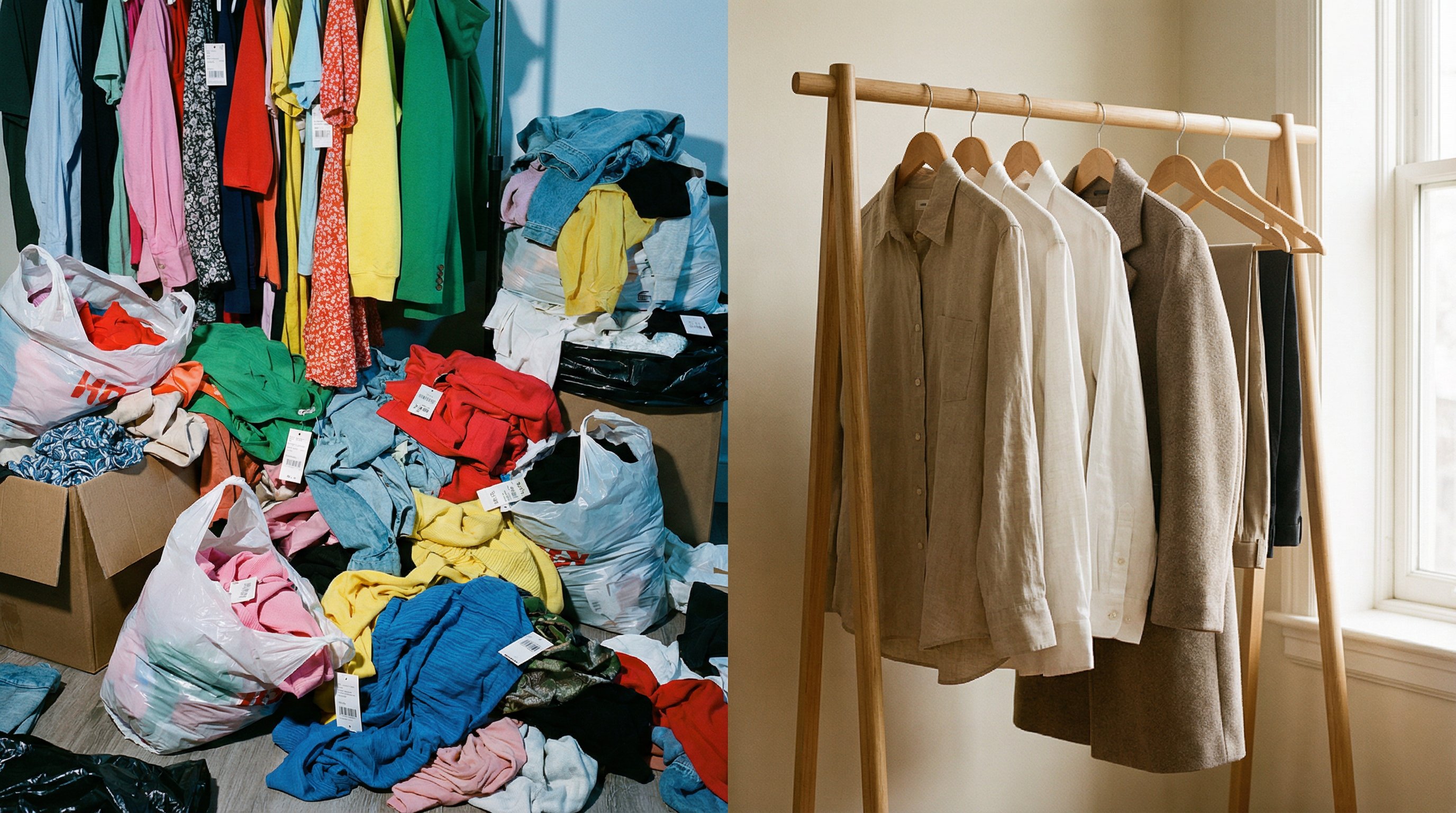
I've been building AI systems that analyze wardrobes and help people understand what they actually wear.
The data reveals something uncomfortable.
The fashion industry has built a business model that requires you to feel inadequate about what you already own. Your contentment is their enemy. Your satisfaction kills their quarterly numbers.
This is the conflict of interest nobody talks about.
The Machinery of Manufactured Dissatisfaction
The average garment gets worn seven times before you discard it.
Seven.
Clothing utilization has dropped 36% compared to fifteen years ago. You're wearing your clothes less, buying more, and feeling worse about both.
This decline happened by design.
Ultra fast fashion brands upload thousands of new garments every single week. The volume creates artificial scarcity and urgency. You feel like your existing wardrobe is inadequate because the industry needs you to feel that way.
The technical term is perceived obsolescence.
Your clothes work fine. They fit. They're not damaged. But you deem them "unusable" because they're no longer trendy. The industry has convinced you that functional clothing has an expiration date based on aesthetics, not utility.
What You Own vs. What You Actually Use
I started tracking wardrobe data because I wanted to understand the gap between what people buy and what they wear.
The numbers are brutal.
82% of items in a typical wardrobe get worn less than three times a year. 40% of consumers admit to buying clothes they never wear. You have an entire category of purchases that deliver zero utility while the industry banks your money.
On average, over one-third of your wardrobe consists of products worn less often than every six months.
You wear about 10% of your clothes on a day-to-day basis.
That means 90% of your wardrobe investment sits idle while companies push more consumption. The average American woman owns 103 items. Experts suggest a sufficient wardrobe could consist of 74 garments and 20 outfits.
The average family spends approximately $1,700 (€1,450) on clothes annually. The average woman has $550 (€470) worth of unworn clothing in her closet.
You're funding inventory that provides no value.
The Acceleration Problem
Fashion cycles used to run on a predictable twenty-year rhythm.
Technology and social media compressed that timeline into months. The 2025 holographic sneaker trend exploded on TikTok and died by late spring. Perfect manufactured ephemerality.
Fast fashion brands now design, produce, and deliver garments in as little as ten days. Zara took two weeks in 2012. Shein does it faster now.
This acceleration serves no consumer need.
It creates artificial urgency. New trends move three times faster than before. Self-expression has been replaced by the attention economy. You're not building a wardrobe—you're performing for an algorithm that rewards novelty over coherence.
1 in 6 young people don't feel they can wear an outfit again once it appears on social media.
The industry has successfully turned clothing into single-use performance props for digital identity.
FOMO as Sales Strategy
Marketing professionals know that FOMO triggers frequently recurring buying behavior.
Research shows that consumers with strong FOMO are less interested in brand credibility when making purchase decisions. Emotion overrides rational consideration. The industry weaponizes this psychological vulnerability deliberately.
Constant access to information via social media puts pressure on you to keep up with what others are saying, doing, and buying.
The fashion industry didn't create FOMO. But they've perfected its exploitation.
Marketing using FOMO-based tactics can be highly effective. The industry has turned anxiety into a sales strategy. You feel like you're missing out if you don't participate in the newest fashion cycles.
Harvard Business Review found that 95% of purchasing decisions occur subconsciously. Fashion marketers capitalize on this through scarcity tactics, limited editions that activate FOMO, and color triggers designed to bypass rational decision-making.
Social media platforms create powerful impulse buying environments. Influencers promote products in aspirational settings. You watch friends or influencers wearing the latest fashion and feel the need to follow their style.
The desired and pressing impulse buy sensation is manufactured.
Planned Obsolescence Isn't New
The concept emerged in the 1920s when manufacturers experimented with ways to limit product lifespans to stimulate demand.
The fashion industry has perfected this strategy through two methods.
Stylistic obsolescence: Trends change faster than your clothes wear out.
Technical obsolescence: Poor quality ensures physical breakdown matches psychological dissatisfaction.
Both approaches serve the same goal. Keep you buying.
The industry produces 92 million tons of waste annually. 85% of all textiles go to the dump each year. Fashion production comprises 10% of total global carbon emissions—as much as the entire European Union.
The business model requires planetary destruction.
Only 8% of textile fibers in 2023 were made from recycled sources. Production doubled from 2000 to 2015 while the duration of garment use decreased by 36%.
You're buying more. Using less. Discarding faster.
What I'm Building Instead
I started LifeGeek AI because I wanted to build systems that help people see their own patterns clearly.
The fashion analyzer doesn't tell you what to buy. It shows you what you actually wear. The wardrobe manager doesn't push trends. It reveals utilization gaps.
When you can see that 82% of your wardrobe sits unused, the industry's manipulation becomes visible.
AI can break this cycle by helping you understand your actual behavior versus manufactured desire. You discover what provides real value instead of what the algorithm thinks you should want.
This is pattern recognition applied to self-perception.
The industry profits when you don't understand your own preferences. They need you confused about what you like, what fits, and what you'll actually wear. Clarity is their threat.
I'm building tools that create that clarity.
The Real Cost of Manufactured Inadequacy
The fashion industry's conflict of interest extends beyond your wallet.
It shapes how you see yourself. Every marketing message tells you that what you have isn't enough. You need the new thing. The trending item. The limited edition drop.
You internalize this message until dissatisfaction becomes your default state.
The average person could buy only 5 new garments per year to align with climate goals. Americans average around 53 new purchases annually.
The gap between what you need and what you buy represents the industry's success at manufacturing inadequacy.
When I look at wardrobe utilization data, I see people who've been trained to distrust their own judgment. You buy clothes you never wear because you've lost the ability to predict what you'll actually use.
The industry benefits from this confusion.
What Happens When You See the Pattern
I'm not telling you to stop buying clothes.
I'm suggesting you understand why you buy what you buy.
When you can see that you wear the same 10% of your wardrobe repeatedly, you start asking different questions. Why did I buy the other 90%? What made me think I needed it? What pattern am I following that doesn't serve me?
The industry doesn't want you asking these questions.
They need you operating on autopilot. Scrolling through feeds. Feeling FOMO. Clicking purchase. Repeating the cycle before you notice the last purchase still has tags on it.
AI tools that reveal your actual behavior patterns disrupt this machinery.
You start to see the gap between industry messaging and personal reality. You notice when trends don't align with your lifestyle. You recognize when scarcity tactics trigger emotional responses that override rational decision-making.
This awareness changes how you interact with fashion marketing.
The System Revealing Itself
I'm building lifestyle AI that starts with fashion because clothing decisions are low-stakes entry points into larger behavioral patterns.
The wardrobe analyzer becomes a pattern recognition engine. The preference mapping system. The contextual awareness framework.
Once you understand how the fashion industry manipulates your perception, you start seeing the same mechanics everywhere. Tech companies. Food marketing. Fitness trends. Financial products.
The substrate is the same. Create dissatisfaction. Offer a solution. Repeat before satisfaction sets in.
I'm not interested in adding another layer to this machinery.
I'm building systems that help you see the machinery clearly enough to make different choices. The kind that align with what you actually value instead of what someone convinced you to want.
Your contentment might be the fashion industry's enemy.
But it's the foundation of everything I'm trying to build.