Sell the Wardrobe You've Outgrown to Fund the One You Actually Need
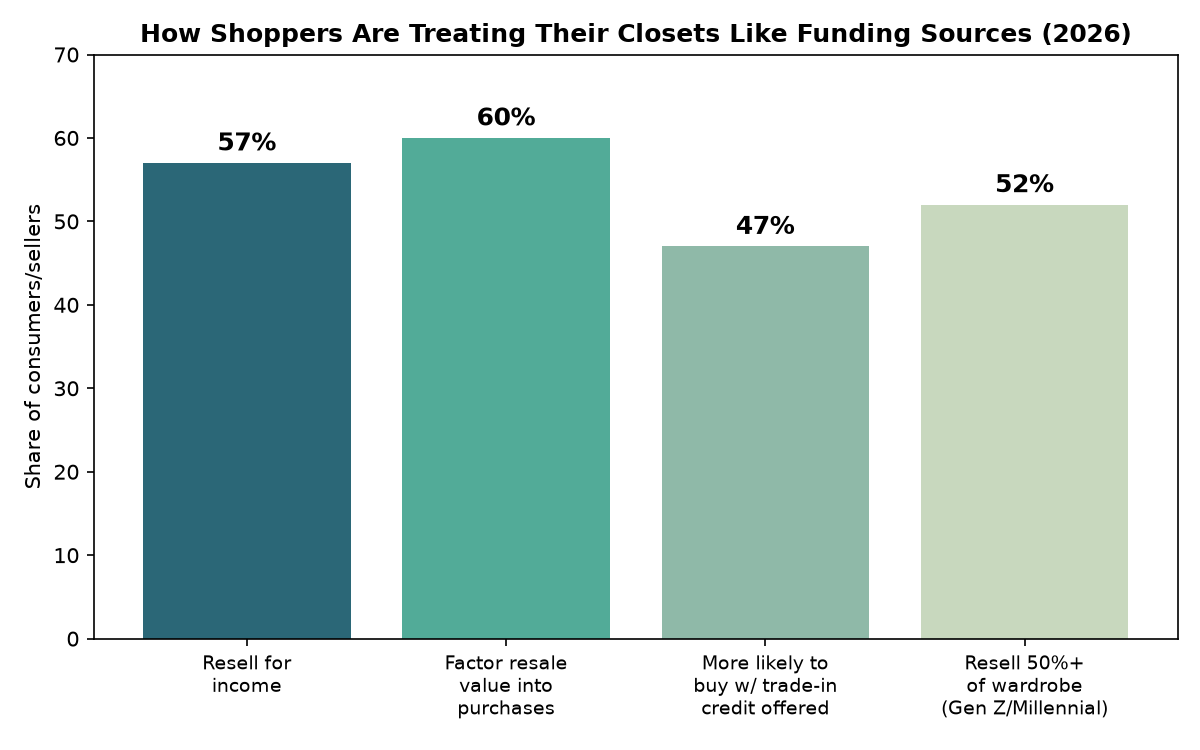
Quick answer: If a divorce, career pivot, or empty nest has left you with a closet full of clothes that no longer fit your life, the fastest way to afford a wardrobe that does isn't a bigger budget — it's selling what's already hanging there. ThredUp's 2026 Resale Report found that 57% of sellers now resell clothes for income, more than double the year before, and 60% of consumers factor an item's resale value into what they buy next, up 13 points year-over-year. That shift turns your old closet from dead weight into a funding source for your next one.
The wardrobe problem nobody budgets for
Every piece of advice about reinventing your style after a big life change focuses on what to buy next: the interview capsule, the travel wardrobe, the "new you" pieces. Almost none of it addresses the money question sitting right in front of you — a closet full of clothes for a life you're no longer living, which took real money to build and is now just taking up space.
That's not a small amount of dormant value. A career-focused wardrobe, a decade of "couple" clothes, or a rotation built around school pickups and PTA meetings represents hundreds, sometimes thousands, of dollars of clothing you're unlikely to wear again — sitting in a closet instead of funding what you actually need now.
Selling for income isn't a fringe behavior anymore
According to ThredUp's 14th Annual Resale Report, released in April 2026, the economics of secondhand have flipped from "declutter for a little extra cash" to something much closer to a real financial strategy:
- 57% of ThredUp's sellers now say they're reselling for income — more than double the share who said so the year before, per ThredUp's 2026 Resale Report as analyzed by Pre-Loved.
- 60% of all consumers now factor "resale value" into their new apparel purchases, up 13 percentage points year-over-year, per the same report.
- 52% of Gen Z and Millennials attempt to resell more than half their wardrobes, according to Circular's breakdown of the ThredUp 2026 Resale Report.
- 47% of consumers say they're more likely to make a first purchase from a retailer that offers trade-in credit, per the same analysis — a strong signal that "sell first, then buy" is becoming the default shopping loop, not a niche behavior.
ThredUp's own SVP of Marketing put the mindset shift plainly in that report: shoppers are moving away from just looking at the price tag, toward calculating the lifetime value of a garment — mentally offsetting the cost of something new with what they expect to get back for it later. That's exactly the math that makes selling your old wardrobe worth doing deliberately, not as an afterthought once the new pieces are already in your cart.
The secondhand market backing this behavior isn't small or shrinking, either. The global secondhand apparel market grew 13% in 2025 to roughly $257 billion and is projected to reach $393 billion by 2030 — more than twice the growth rate of overall apparel retail, per Circular's summary of the same ThredUp data.
The closet-as-asset shift, by the numbers
Source: ThredUp 2026 Resale Report, via Pre-Loved and Circular
Why this matters specifically during a life transition
Rebuilding a wardrobe after a divorce, a career change, or an empty nest is already a financial squeeze layered on top of an emotional one. You're often absorbing new costs — a new apartment, retraining, travel, therapy, a different commute — at the exact moment you also need different clothes. Treating your existing closet as a funding source rather than sunk cost does two things at once: it clears physical and mental space for who you're becoming, and it directly offsets what the new wardrobe costs.
This isn't just a budget hack for people in their 40s and 50s, even though that's often where career pivots, divorces, and empty nests cluster. A 28-year-old leaving a relationship or a first job has the same dead-weight closet problem, just a shorter wardrobe history. The "sell what no longer fits your life, buy what does" cycle works at any age and any transition.
How to actually run the sell-then-buy cycle
- Sort by relevance to your next chapter, not by condition. A barely-worn blazer from your old corporate job is still dead weight if you're pivoting into a field where nobody wears one. Sell based on fit with where you're going, not how new it looks.
- Sell on the same kind of marketplace you'll buy from. Selling and rebuying on eBay, for instance, keeps the cycle simple — proceeds from one listing can go straight toward the next purchase instead of getting lost across five different apps.
- Price for turnover, not nostalgia. Items tied to an old identity often get overpriced by sentiment. Faster turnover means faster funding for the wardrobe you actually need now.
- Reinvest deliberately, not impulsively. Don't let resale income evaporate into random purchases. Decide what the new chapter actually requires — a work capsule, travel pieces, a fresh everyday look — before you start rebuying.
- Use AI chat to close the loop on the buying side. Once you know your budget from what you've sold, describe what you actually need — "professional but not corporate, budget $150, need it by next Friday" — and let an AI stylist search live marketplace listings for pieces that match, instead of scrolling for hours trying to spend the money well.
Where AI fashion discovery fits into this cycle
The selling side of this equation already has established tools — ThredUp, eBay, Poshmark, and others make it straightforward to turn a closet into cash. The harder part has always been the buying side: once you have a hundred or a few hundred dollars from selling your old wardrobe, spending it well on the right new pieces, fast, without losing hours to search filters that don't understand what "the next chapter of my life" actually means.
That's the specific gap a chat-first AI stylist closes. Instead of typing generic keywords into a marketplace search bar, you describe the moment you're dressing for — the job, the trip, the weather, the budget you just freed up by selling what no longer fits — and get back real, buyable pieces sourced from live eBay listings. It's the natural second half of the sell-then-buy cycle the resale data shows more people are already running.
Frequently asked questions
Is selling old clothes actually worth the effort, or is it more trouble than it's worth? The data suggests more people think it's worth it every year — ThredUp's 2026 report found the share of sellers reselling specifically for income more than doubled year-over-year, to 57%. For a wardrobe you're not wearing anyway, even modest per-item returns add up toward funding new pieces.
Do I need to sell everything before I buy anything new? No. The point isn't an all-or-nothing purge — it's treating your closet as a funding source rather than ignoring its value. Selling even a portion of an outdated wardrobe can meaningfully offset what a handful of new, well-chosen pieces cost.
Is this only relevant to people going through dramatic life changes? No, but it's especially relevant then. A closet built around a career, relationship, or routine you've moved past holds real, often-overlooked value right when you need funds for the next chapter most.
Where should I sell, and where should I buy? Both can live on the same type of marketplace. eBay works for both selling items you no longer need and buying pieces that fit who you're becoming, which keeps the "sell to fund the new" cycle simple to track.
Try the buying half of the cycle
Once you've sold what no longer fits your life, try LifeGeek's AI fashion chat to spend that budget well. Describe the job, the trip, the weather, or the moment you're dressing for, and it searches real eBay listings for pieces that actually match — no quiz, no wardrobe upload, no hours lost to search filters.